We care, and it shows. You’re not just a number to us. We listen, and we ask questions. We strive to improve our client’s lives every day.






If you are a homeowner, a retirement account holder, or part of a married couple, you have probably thought about what long-term care could cost. Maybe you have watched it happen to someone else’s family. Maybe you are starting to think about your own parents. Maybe you are simply doing the math and not liking what you see.
The question most families ask is: does getting the care we need mean losing everything we have worked for?
It doesn’t have to. But only if the right planning happens at the right time.
At Safe Harbor Estate Law, we work with Minnesota families navigating exactly these situations. We are here to listen first, answer your questions without pressure, and help you understand what is genuinely possible for your family.
“Safe Harbor was great to work with. Very friendly and they walked us through every step of the way so that we understood the entire estate planning process. We highly recommend them for your planning needs.”
– D. W.
“Safe Harbor was and is very helpful in educating on what our options are and how they can impact the processes of the “what if’s”. It is nice to know we have someone we can continue to reach out to when things occur. I feel great that I have my estate documents completed with this firm.”
– L. L.
“Safe Harbor has been excellent to work with. Their asset protection and trusts are very complicated but they work to make it easy to understand and to complete the process. The staff is very professional and are available for any questions at any time.”
– M. P.
“The process of estate planning was very smooth, informative, and comprehensive from start to finish. Safe Harbor has the knowledge and expertise with a genuine interest in developing and implementing our plan.”
– M.
“Excellence, expertise, and efficiency. At Safe Harbor Estate Law you get to work with the best. They are experts at navigating complex and tricky issues. Every person is warm and kind, always looking to make sure every issue is taken care of correctly and quickly. Cannot recommend a place more highly!”
– S. W.
Long-term care planning is the legal and financial process of preparing for a time when you, or someone you love, can no longer manage daily activities independently.
That may mean living in a nursing home, an assisted living facility, or receiving home-based care from a professional caregiver.
Long-term care planning uses legal tools, including trusts, Medicaid applications, spousal protection strategies, and benefit programs, to help you keep as much of your estate as possible while still qualifying for the care you need.
It is not about gaming the system.
It is about understanding the rules and applying them correctly before a health crisis forces your hand.
If you are just beginning to think through this, our free guide Ways to Stay Out of the Nursing Home is a helpful starting point for families weighing their options.
The families who benefit most from this kind of planning tend to fall into a few categories, though no two situations are exactly alike:
If you recognize your family in that list, the most important thing you can do right now is start a conversation while your options are still open.
Minnesota has its own Medicaid program, called Medical Assistance, with rules set by the Minnesota Department of Human Services and administered at the county level. Understanding how those rules work is essential to protecting your family. Safe Harbor’s Smooth Sailing System incorporates our entire team’s expertise in walking families through exactly this kind of planning.
When you apply for Medicaid long-term care benefits, Minnesota reviews five years of financial history. If assets were transferred for less than fair market value during that window, Medicaid may impose a period of ineligibility, even if you otherwise qualify. This is the single most important reason to start planning early. Families who act before the lookback window closes have far more options than those who wait for a crisis.
For a single applicant, Minnesota Medical Assistance generally limits countable assets to a small threshold. For married couples, the Community Spouse Resource Allowance (CSRA) allows the at-home spouse to keep a meaningful portion of the couple’s combined assets, along with additional income protections. These rules exist specifically to prevent the healthy spouse from being left financially vulnerable while their partner receives care.
Minnesota’s Elderly Waiver allows qualifying seniors to receive Medicaid-funded care in their own home or a community setting rather than a nursing facility. For families who want a spouse or parent to stay home, this program can be a genuine lifeline, and with proper planning, it does not have to mean spending down everything first.
Learn more about the Minnesota Elderly Waiver here.
Under Minnesota law, the state may seek reimbursement from a deceased Medicaid recipient’s estate for benefits paid. For families who own a home, this is a real concern. Legal structures put in place before benefits begin may reduce or limit that exposure. This is something we address directly in planning, not something families should discover after the fact.
Most law firms approach long-term care planning as a Medicaid application problem. Safe Harbor Estate Law approaches it as a whole-family planning problem, and that distinction matters.
Our team has been directly involved in shaping how Minnesota courts interpret Medicaid planning law, including a 2021 Minnesota Court of Appeals decision that expanded how irrevocable trusts can be used in this state. That isn’t just legal trivia: it means the strategies we recommend are grounded in firsthand experience with how these rules actually hold up, not just how they read on paper.
For families with assets between $500,000 and $3,000,000, combining long-term care planning with a Medicaid asset protection strategy is often the most important financial decision they can make. It’s the kind of depth that’s difficult to find elsewhere in Minnesota, and it’s built into how every attorney on our team approaches a case.
For a plain-language overview of how irrevocable trusts factor into this planning, see our free resource: An Important New Tool for Medicaid Planning in MN.
If you have never worked with a long-term care planning attorney before, here is a straightforward overview of what to expect at Safe Harbor Estate Law:
We know this is the question most families want answered.
The honest answer is that it depends on your asset mix, your timeline, your family structure, and which planning tools are available to you.
With proper planning, families may be able to protect:
Past results in long-term care planning cases do not guarantee similar outcomes. Every family’s situation is different, and results depend on the specific facts, timing, and legal strategies available at the time of planning.
Safe Harbor Estate Law offers several free guides for families navigating these decisions.
You do not need to be a client to benefit from them.
Several legal strategies may help, depending on how much time you have. Irrevocable trusts, spousal protection rules, and the Elderly Waiver program are among the most commonly used tools in Minnesota. The most effective plans start at least five years before care is needed, but planning done two to three years out still has significant value, and even crisis-stage planning can protect meaningful assets in many situations.
Minnesota has an estate recovery program that may file a claim against your estate after death if Medicaid paid for your care. With proper planning, particularly for married couples or homeowners with a disabled child, it may be possible to protect the home from estate recovery. This is a fact-specific issue that requires legal advice tailored to your situation.
The ideal window is five or more years before you anticipate needing care. Planning in your 50s or early 60s typically provides the most flexibility and the widest range of options. That said, even families facing an immediate care need have more options than they often assume. An early conversation with our team gives you the clearest picture of what is possible.
Fees vary depending on the complexity of the plan and the documents involved. For many families, the cost of planning is a fraction of what a single month of nursing home care would cost without protection in place. All attorney time at Safe Harbor Estate Law is paid from the first conversation. This ensures you receive focused, substantive legal guidance, not a sales pitch.
Minnesota’s Elderly Waiver provides Medicaid-funded home and community-based services to seniors who would otherwise require nursing home care. Eligibility requires meeting nursing-facility level-of-care criteria and Medicaid financial requirements. A waitlist applies. Our team can help you assess eligibility and position your finances to qualify while protecting as much of your estate as possible.
Medicare is a federal program that covers short-term skilled nursing care, typically up to 100 days following a qualifying hospital stay. It does not cover ongoing custodial long-term care. Medical Assistance, Minnesota’s Medicaid program, is the primary public benefit that covers long-term nursing home or home-based care for those who qualify financially. Planning for Medical Assistance eligibility is a very different process than Medicare planning.
Yes. While early planning provides the most options, crisis Medicaid planning can still protect a meaningful portion of assets in many situations. Our attorneys move quickly and strategically when time is short. If a nursing home admission is already imminent or underway, the most important thing you can do is reach out as soon as possible so we can assess what options remain available.
Veterans Aid and Attendance is a benefit available to wartime veterans and surviving spouses who need help with daily activities. It can provide meaningful monthly income to offset the cost of assisted living or in-home care. For eligible families, it is an important piece of a broader long-term care plan. Our team includes this in our planning analysis for any client who may qualify.
Long-term care planning in Minnesota is not simple, and there is no default answer that works for every family.
The families who protect the most are the ones who plan early and get guidance that is specific to their situation, not advice copied from another state’s playbook or pulled from a generic checklist.
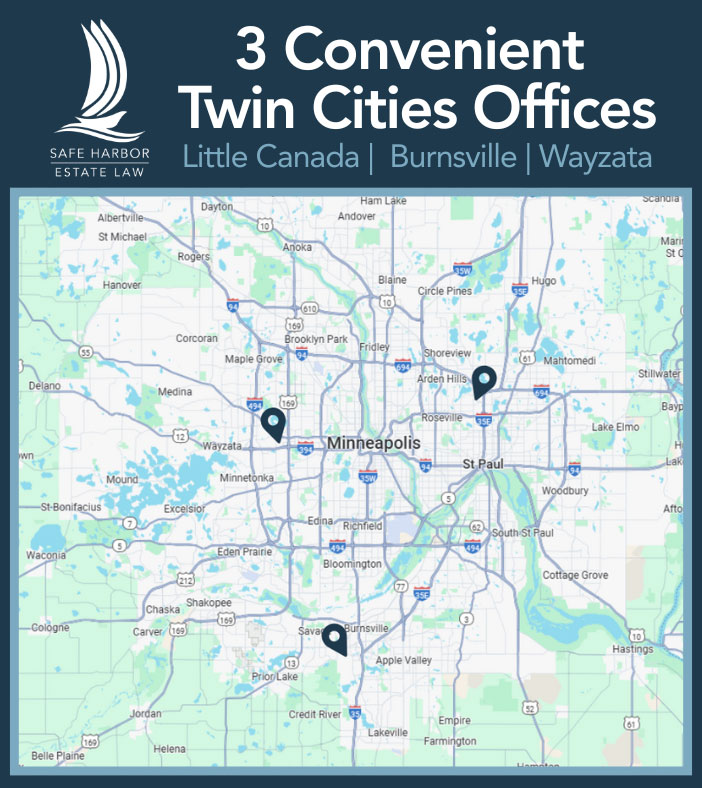
Safe Harbor Estate Law serves clients across the Saint Paul area, Burnsville, Wayzata, and throughout Minnesota and Wisconsin. We understand that long-term care planning can feel overwhelming, and our team is here to listen first and answer your questions without pressure.
To get started, call (612) 615-9535. You will speak with a client intake specialist who will make sure you are connected with the right person for your situation.

Every person at Safe Harbor Estate and Elder Law is helpful and professional, while being friendly and putting you at ease. They know that this is not an every day event for people, and that clients may be uncomfortable. Everyone there does everything they can to make the process easy and smooth sailing. Margaret and her team genuinely want to protect

Safe Harbor Estate Law first worked with me in 2017 to complete my Living Will and Estate Plan. They were very thorough and everything went smoothly. What really impressed me about them was how they worked to iron out the issues when I was refinancing with Wells Fargo. Safe Harbor’s lawyers interceded on my behalf to clarify the issues with the title

Absolutely experts at what they do. Really solid organization their process is well thought out and well practiced. I had very similar work done several years ago by another firm and Safe Harbor Estate Law fixed their work and provided a much better result in both less time and money. Everybody at this firm completes their role very efficiently and

We were very pleased with the service from Safe Harbor. After years of procrastinating, we finally decided we needed to move forward and get our estate planning completed, which involved setting up a living trust. We were surprised at how easy it turned out to be. Safe Harbor tailored our will and trust documents to some unique need we had and all is now

I had put off getting a will done for 6 years, even after being diagnosed with Multiple Myeloma 4 years ago. Then I watched Safe Harbor’s webinar just to learn some will/estate planning information. That webinar answered so many questions for me and made me realize the big mistake I was making by not finalizing a will. So I scheduled a consultation immediately

Safe Harbor Estate Law was recommended by a lawyer friend. From the very beginning I was impressed with the respect and compassion with which we were treated. My goal was to come away with a plan that would protect our assets. I now have that plan which is very thorough, providing me with peace of mind. Working with the team at Safe Harbor Estate Law was a positive experience. All of the attorney I worked with were very professional. Michael Teeter, especially, is knowledgeable, explaining all the complexities. He was also patient and responsive in answering my follow-up questions, often more than once.
The process of creating our Trust
was incredibly smooth. From the initial zoom informational meeting to the meeting with the well versed attorney and the final signing, we felt confident and informed.
I hired Safe Harbor Estate Law to do my estate plan including a living trust, power of attorney, and health care directive. They made the process easy by explaining everything clearly, being organized, and answering my questions.
They listened to our wants and needs and drafted the documents we needed to feel secure in having the best estate plan possible for us and our family.
See what other Safe Harbor Estate Law clients are saying about their experience.
We care, and it shows. You’re not just a number to us. We listen, and we ask questions. We strive to improve our client’s lives every day.
Our firm goes above and beyond to make you feel comfortable throughout the process so you feel informed and confident every step of the way.
We help you leave a legacy that is smoother, less expensive, and less hassle for your loved ones with a plan that is uniquely tailored to your goals.
Our team is motivated to help you experience smooth sailing from start to finish so everything is done thoroughly and properly.
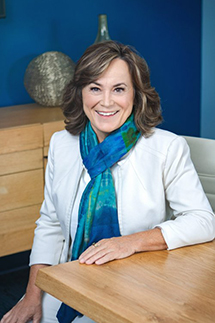







I attended a free seminar to learn about getting a Will. I learned so much more than I expected! I then hired Safe Harbor Estate Law to create a Will, POA and Trust. The process was very simple!
I highly recommend everyone to contact Safe Harbor to help you too!