What Does a Nursing Home Cost in Minnesota in 2026: What Families Need to Know

Nursing home costs in Minnesota can be expensive!
A semi-private nursing home room in Minnesota costs a median of $10,646 a month ($127,750 a year), and a private room costs a median of $13,870 a month ($166,440 a year), according to the CareScout (Genworth) 2025 Cost of Care Survey, both well above the national medians of $9,581 and $10,798.
Those are statewide figures. Cost varies meaningfully by region within Minnesota:
- Twin Cities metro (Minneapolis, St. Paul, Bloomington, and the surrounding area served by our Burnsville, Wayzata, and Saint Paul offices) typically prices at or above the statewide median, reflecting higher labor and real estate costs.
- Greater Minnesota and Western Wisconsin communities, including areas around Hudson, often run somewhat below the statewide figure, though skilled memory care and specialty units can close that gap quickly.
At either figure, a multi-year nursing home stay can consume $300,000, $500,000, or more of a family’s lifetime savings.
The average nursing home stay in the U.S. runs about 2.5 years, long enough to turn a six-figure retirement account into $0 if there’s no plan in place.
That’s the real question behind almost every search for “nursing home cost Minnesota”: not just what will this cost, but how do I keep this from wiping out everything I’ve built.
The rest of this article walks through exactly that.
Won’t Medicare Cover This?
This is the single most common misconception we hear from families, and it’s an expensive one to get wrong.
Medicare does not pay for long-term nursing home care.
Medicare will cover the first 20 days in full after a qualifying hospital stay of at least three days. From day 21 through day 100, a daily copayment of $217 applies. After day 100, Medicare coverage stops completely.
No exceptions, no extensions.
What Medicare covers is short-term skilled care: rehab after a hip replacement, recovery after a stroke, that kind of thing.
What most nursing home residents actually need is custodial care, help with bathing, dressing, eating, and daily living over months or years, and Medicare was never designed to pay for that.
That gap is why this becomes a Medicaid question, not a Medicare question, for the vast majority of families.
Who Actually Pays for Nursing Home Care in Minnesota?
Once Medicare’s limited coverage runs out, families generally rely on one or a combination of three sources.
Private Pay
If your assets are above Minnesota’s Medicaid limits, you’ll pay out of pocket until you spend down to qualify. For a family with $300,000 in savings, that can mean $10,000 or more per month leaving the household before Medicaid ever steps in, which is exactly why long-term care planning done in advance matters so much: it’s the difference between spending down on your own terms and spending down in a crisis.
Long-Term Care Insurance
If your loved one purchased a long-term care insurance policy years ago, now is the time to review it, coverage triggers, elimination periods, and daily benefit caps vary widely by policy, and claims should be filed as soon as a qualifying need for care begins.
Medicaid (Medical Assistance in Minnesota)
Medicaid, called Medical Assistance (MA) in Minnesota, is the primary public program that covers long-term nursing home care, and it’s the option most families end up relying on. But qualifying isn’t simple.
Asset limits for nursing home care:
- Single applicant: $3,000 or less in countable assets
- Married couple (both applying): $6,000 combined
- Married couple (one spouse applying): The applicant spouse is limited to $3,000; the community spouse may keep up to $162,660
Income limits (effective July 2025 through June 2026):
- Single applicant: $1,305 per month or less
- Recipients keep only $132 per month as a personal needs allowance; the rest goes toward the cost of care
Retirement accounts, bank accounts, stocks, and bonds all count as assets. You can keep a home only if you or your spouse is living in it (there’s a very limited child caregiver exception), and Minnesota caps home equity at $752,000 in 2026.
The state will also place a lien on the home to recover care costs when it’s eventually sold, a process called Estate Recovery.
This is where Medicaid planning stops being optional advice and starts being the thing that determines whether your family keeps a meaningful share of what you’ve built.
Protecting Your Assets: The 5-Year Lookback, Spend-Down, and MAPT Planning
Here’s the good news families don’t hear often enough: in many cases you can protect 40–80% of the assets you’d otherwise be required to spend down, but timing is everything.
The 5-Year Lookback Rule
When someone applies for Medicaid, the state looks back five years to see whether assets were given away or transferred below market value. If they were, Medicaid imposes a penalty period that delays eligibility (Minnesota Statutes, Section 256B.0595).
Many families assume they can simply give money to their kids or move assets to a relative to qualify sooner. In most cases, that “strategy” backfires, it triggers a penalty period, and your loved one could be at risk of losing their place in a care facility if family members can’t cover the bill during that penalty window.
What this means practically:
- The 5-year lookback applies to both nursing home Medicaid and the Elderly Waiver program for care at home, in assisted living, or in memory care.
- It’s best to plan more than 5 years before you expect to need care.
- Legal tools, Medicaid Compliant Annuities, irrevocable trusts, can move assets outside Medicaid’s reach, but only when structured properly by an elder law attorney who handles Medicaid planning and application regularly. This is a very complicated area of law, and only about 5% of estate attorneys focus on it.
Medicaid Asset Protection Trusts (MAPTs)
Placing assets into a properly structured Medicaid Asset Protection Trust can allow those assets to fall outside Medicaid’s countable asset rules once the 5-year lookback period has passed. Minnesotans have only been able to use MAPTs since a July 2021 Minnesota Court of Appeals decision, our own Lead Asset Protection Attorney, Michael Teeter, helped write the legal brief that won that case.
Minnesota’s MAPT rules are stricter than many other states’, so this tool needs a careful, individualized evaluation, and it works best when started years before care is needed.
Medicaid-Compliant Annuities
These specialized annuities let one spouse transfer assets to another while preserving deferred taxation on retirement assets, and they can also address past gifts that might otherwise trigger a penalty period.
Safe Harbor is the only firm in Minnesota to receive the Krause Gold Partner Award for protecting more client assets with Medicaid Compliant Annuities than any other Minnesota firm, in both 2024 and 2025 we helped clients save over $5 million in 2025 through this strategy alone.
Spousal Protections
If one spouse needs nursing home care and the other doesn’t, the community spouse resource allowance lets the healthy spouse keep up to $162,660 in assets (2026 limit), plus a minimum monthly income allowance of $2,645. A custom Medicaid asset protection plan can protect additional funds for the healthy spouse beyond those baseline figures.
Strategic Spend-Down
Spending down assets on exempt items, home modifications, a vehicle, prepaid funeral and burial arrangements, or payments for care, can help a family qualify for Medicaid more quickly without giving up everything. Always consult a Medicaid elder law attorney before spending down, since the rules on what qualifies are specific and unforgiving.
Is it too late if a loved one is already in a nursing home? Not necessarily. Medicaid Compliant Annuities and other tools can still help even after a care crisis has started — many families assume it’s too late and give up assets they didn’t have to lose.
Federal Medicaid Changes Are Coming: What the One Big Beautiful Bill Act Means for Nursing Home Families
A new federal law, the One Big Beautiful Bill Act (OBBBA, or H.R. 1) is reshaping Medicaid nationwide, and it’s worth a quick, accurate word here because there’s a lot of confusion circulating about it.
Most of OBBBA’s headline changes don’t apply to nursing home Medicaid.
The new 80-hour-a-month work requirement and the switch to six-month renewals apply only to the ACA “expansion” adult population (generally non-disabled adults ages 19–64 who qualify on income alone), not to the Aged, Blind, and Disabled pathway that nursing home applicants use.
The one OBBBA change that does matter here:
Starting January 1, 2027, retroactive Medicaid coverage, the ability to have Medicaid pay for care costs incurred before the application was filed, shrinks from three months to two months for Aged, Blind, and Disabled Medicaid (including nursing home Medicaid).
A Minnesota Medicaid application for nursing home care typically requires five or more years of financial records, and families often need weeks to assemble it. With a shorter retroactive window, applying as early as possible after a loved one enters care matters more than it used to.
OBBBA also tightens Medicaid eligibility for certain noncitizen immigration statuses starting October 1, 2026, which can affect nursing home Medicaid eligibility for a family member without permanent resident status. If this applies to your family, an elder law attorney can walk through your specific situation.
Frequently Asked Questions About Nursing Home Costs in Minnesota
How much does a nursing home cost per month in Minnesota?
The CareScout 2025 Cost of Care Survey puts the median at $10,646 a month for a semi-private room and $13,870 a month for a private room, with Twin Cities metro facilities typically running at or above that figure.
Does Medicare pay for nursing home care in Minnesota?
Only in a limited way, up to 100 days after a qualifying hospital stay, with a copayment after day 20, and only for skilled care, not long-term custodial care. See “Won’t Medicare Cover This?” above.
What is the Medicaid asset limit for nursing homes in Minnesota?
In 2026, a single applicant must have $3,000 or less in countable assets. For a married couple where one spouse is applying, the community spouse may keep up to $162,660.
How can I protect my assets from nursing home costs in Minnesota?
Tools like Medicaid Compliant Annuities, Medicaid Asset Protection Trusts, spousal protections, and strategic spend-down can each play a role, the right combination depends on your timeline and situation. See the planning section above.
Does the One Big Beautiful Bill Act affect nursing home Medicaid in Minnesota?
Only narrowly. The new work requirements and six-month renewals apply to a different Medicaid population. The change that matters for nursing home families is a shorter retroactive coverage window starting in 2027, one more reason to apply early.
The Best Time to Plan Is Before You Need a Nursing Home
Once a loved one is already in a nursing home, the options narrow.
The families who protect the most are the ones who plan early, ideally more than 5 years ahead. If you have less time than that, or you’re already paying for care, we routinely help clients save significant amounts in spite of the 5-year lookback.
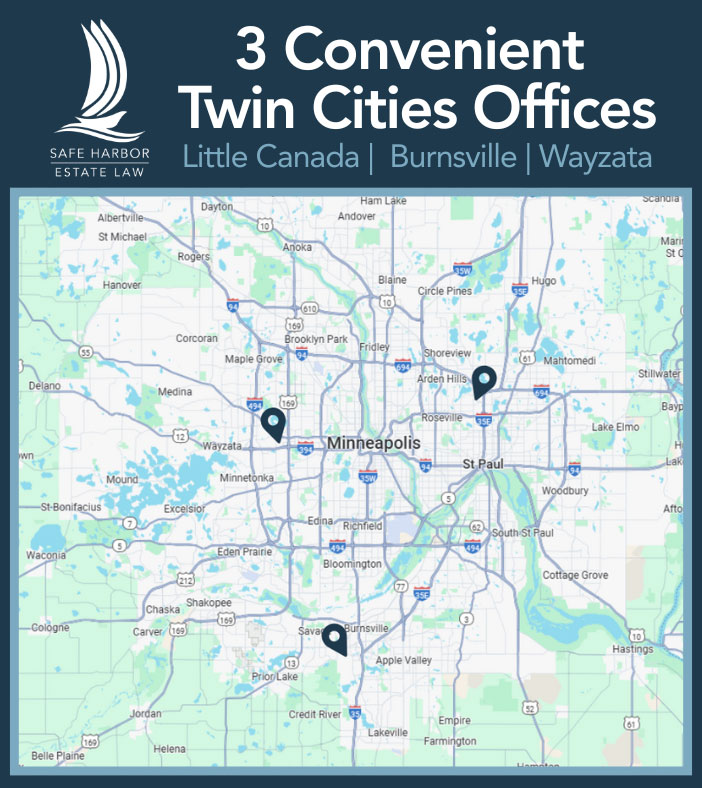
Safe Harbor Estate Law has offices in Saint Paul, Burnsville, and Wayzata, serving families throughout the Twin Cities, Greater Minnesota, and Western Wisconsin. Our team has a major focus on Medicaid planning, Medicaid-compliant annuities, and elder law and we’re here to help you understand your options before a crisis forces the decision for you.
This post is for general informational purposes only and does not constitute legal advice. Laws and Medicaid limits change regularly, and federal implementation of the One Big Beautiful Bill Act is still rolling out through 2027 and 2028. Please verify current figures at mn.gov/dhs or speak with a licensed Minnesota elder law attorney. Results may vary based on individual circumstances.
Author Bio

Margaret Barrett is the Founder and Owner of Safe Harbor Estate Law, a Saint Paul, MN, estate planning law firm she founded in 2013. With almost 15 years of combined experience in litigation and Minnesota estate law, she is dedicated to representing clients in a wide range of estate law matters. Her practice areas include estate planning, asset protection, elder law, and more.
Margaret received her Juris Doctor from the William Mitchell College of Law and is a member of the Minnesota State Bar Association and the Ramsey County Bar Association.